The History of Geomancy: From Ancient Divination to Modern Practice
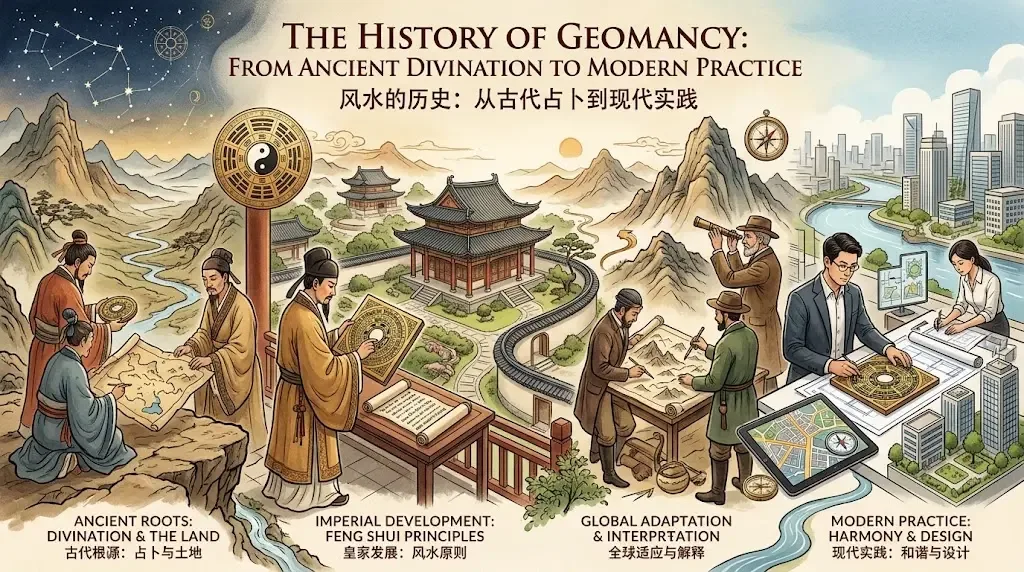
Geomancy is one of the oldest forms of divination in the world. Its name comes from the Greek words geo, meaning “earth,” and manteia, meaning “divination.” In its simplest form, geomancy involves creating or interpreting patterns of marks, traditionally on the ground, and using those patterns as a symbolic system for answering questions and understanding situations.
Although geomancy is often associated with medieval Europe and the Islamic world today, its history is much broader. Over centuries, different cultures developed related practices of reading patterns, numbers, marks, and natural signs. What we now call geomantic divination developed through a long process of transmission, adaptation, and reinterpretation.
This article explores how geomancy developed, how it traveled between cultures, and how the traditional system continues to be practiced today.
What Is Geomancy?
Before looking at its history, it is useful to understand what geomancy actually does.
Traditional geomancy generally begins with the creation of a series of apparently random marks. Historically, a practitioner might make dots or lines in sand or soil without consciously counting them. The resulting patterns are then reduced according to an odd-and-even system.
These patterns produce geomantic figures, each consisting of four rows. Every row contains either one or two points.
The combination of these four rows creates one of sixteen possible figures.
These sixteen figures form the basic vocabulary of the geomantic system. Through a structured process, they can be combined into a larger chart, traditionally known as a shield chart or house chart, which allows the practitioner to examine a question from different symbolic perspectives.
In this sense, geomancy is not simply “reading the earth.” It is a formal divination system based on randomness, binary patterns, figures, houses, and interpretation.
The Ancient Roots of Geomancy
The exact origin of geomancy remains uncertain.
This is one of the most interesting aspects of its history.
Unlike some divination systems with relatively clear historical founders or surviving early manuscripts, geomancy appears to have developed through cultural transmission rather than being created by one identifiable individual.
The practice is often connected with older traditions of divination based on marks, numbers, and random patterns. Ancient cultures throughout Africa, the Middle East, and the Mediterranean used various methods of interpreting signs and patterns.
However, it is important not to assume that every ancient practice involving marks on the ground was the same system as the geomancy practiced later.
Historical evidence suggests that the geomantic system familiar today emerged most clearly within the medieval Islamic world.
Geomancy in the Islamic World
The medieval Islamic world played a crucial role in the development and preservation of geomancy.
The Arabic name commonly associated with geomancy is ʿilm al-raml, meaning “the science of sand.” This name reflects one of the traditional methods of practicing the art: making marks or patterns in sand and then interpreting the resulting figures.
During the medieval period, geomancy became an established form of divination and was discussed in Arabic manuscripts.
One of the most frequently mentioned figures in the history of geomancy is Abū Maʿshar al-Balkhī, although the exact relationship between individual scholars and the development of geomancy can be difficult to establish from surviving historical sources.
Arabic and Persian intellectual traditions helped organize geomancy into a sophisticated system. The sixteen figures were associated with various meanings, qualities, directions, planetary influences, and other symbolic correspondences.
Geomancy therefore evolved beyond a simple method of making random marks.
It became a complete divinatory framework.
How the Sixteen Figures Became Central
The sixteen geomantic figures are at the heart of traditional geomancy.
Each figure contains four lines, with each line having either one point or two points.
For example:
• •
•
• •
•
and
•
• •
•
• •
represent different figures.
Because each of the four rows can contain either one or two points, there are:
2 × 2 × 2 × 2 = 16
possible combinations.
This gives geomancy its distinctive structure.
The figures are not interpreted independently. In a traditional reading, figures are generated from the initial patterns and then transformed through a series of rules to produce additional figures.
This mathematical structure is one reason geomancy has remained fascinating to both diviners and modern students of historical divination.
The Journey from the Islamic World to Europe
Geomancy eventually traveled from the Islamic world into medieval Europe.
This transmission was part of a much larger movement of knowledge. During the Middle Ages, European scholars translated numerous Arabic works concerning astronomy, astrology, medicine, mathematics, philosophy, and occult sciences.
Geomancy was among the traditions that entered the European intellectual environment through these channels.
By the medieval and Renaissance periods, geomancy had become known in Europe as geomantia.
European practitioners adapted the system to their own intellectual traditions. Geomancy became closely connected with astrology, planetary symbolism, the zodiac, and the twelve astrological houses.
This produced a distinctive European form of geomantic practice.
Geomancy and Astrology
One of the most important developments in European geomancy was its relationship with astrology.
Traditional geomantic charts contain twelve houses, similar to an astrological chart.
Different houses represent different areas of life.
For example, the first house can relate to the querent or the self, while other houses can concern money, communication, family, relationships, career, travel, and other subjects.
The geomantic figures placed within these houses are then interpreted according to the question being asked.
This made geomancy particularly useful for questions involving concrete circumstances.
A person might ask:
Will I succeed in this business?
Should I travel?
Will I receive the money I am expecting?
What is happening in this relationship?
Is this a good time to pursue a particular plan?
Rather than producing a simple symbolic message, geomancy attempts to construct a structured picture of the situation.
Geomancy During the Renaissance
Geomancy continued to attract interest during the Renaissance.
This was an era when astrology, magic, alchemy, philosophy, mathematics, and religious thought were often studied alongside one another.
Some Renaissance scholars considered geomancy a legitimate form of occult knowledge. Others were skeptical of divination or regarded it as incompatible with religious doctrine.
Nevertheless, geomantic texts circulated widely.
One particularly important figure was Heinrich Cornelius Agrippa, whose writings helped preserve and transmit knowledge of Western occult traditions. Geomancy was included within the broader intellectual world of Renaissance occult philosophy.
During this period, geomancy was no longer merely associated with sand or the earth. It had become part of a larger symbolic system involving planets, elements, signs, houses, and numerical relationships.
Geomantic Figures and the Planets
European geomancy increasingly developed planetary associations.
The sixteen figures were connected with different qualities and, in some traditions, with planetary or zodiacal symbolism.
This allowed geomancers to interpret figures through several layers at once.
A figure could have its own intrinsic meaning while also taking on additional significance from:
its position in the chart,
its relationship to other figures,
its planetary correspondence,
its house,
and the specific question being asked.
This layered structure is one of the reasons traditional geomancy can appear complicated to beginners.
It is not simply a matter of memorizing sixteen meanings.
The real skill lies in understanding how the pieces interact.
Geomancy Beyond Europe
Geomantic traditions also developed outside the European context.
Forms of divination involving binary patterns, marked surfaces, and symbolic figures appeared across different regions of Africa and the Middle East.
In West Africa, related traditions became deeply integrated into local religious and divinatory systems. The historical relationship between Arabic geomancy and African forms of divination is complex, involving centuries of cultural exchange, adaptation, and local development.
It is therefore more accurate to think of geomancy as a family of related traditions rather than a single practice that remained completely unchanged from ancient times to the present.
Different cultures gave the system their own meanings, methods, and interpretations.
Geomancy and the Idea of Randomness
One fascinating feature of geomancy is its use of randomness.
The practitioner traditionally does not deliberately choose a figure.
Instead, the figures are generated through an apparently random process.
A common traditional method involves making an arbitrary number of marks and determining whether the number of marks is odd or even.
The result is then converted into a geomantic line.
Repeated several times, this process generates the four lines of a figure.
From a modern perspective, this resembles a random-number generator.
But for a traditional geomancer, randomness has a deeper symbolic meaning.
The random event becomes the starting point for interpretation.
The practitioner does not necessarily believe that the marks themselves contain a literal message. Instead, the divination process creates a symbolic structure through which the question can be examined.
The Shield Chart
One of the most distinctive features of traditional geomancy is the shield chart.
The shield chart organizes the figures generated during a reading into a specific sequence.
Four initial figures are generated first. These are traditionally known as the Mothers.
From them, additional figures are derived, eventually producing the full chart.
The resulting structure contains multiple layers of figures, including:
Mothers
Daughters
Nieces
Witnesses
Judge
and, in some traditions, the Reconciler
The exact terminology and interpretation can vary between traditions.
The important point is that the chart creates relationships between the figures.
A geomantic reading therefore becomes more than sixteen isolated symbols. It becomes a system of relationships.
The Judge and the Question
The Judge is particularly important in many traditional geomantic systems.
It is derived from the figures that come before it and represents the overall outcome or judgment of the question.
This gives geomancy a distinctive logical structure.
A question is introduced.
Figures are generated.
The figures interact according to established rules.
A final figure is produced.
The practitioner then interprets that result in relation to the original question.
This combination of randomness and structure is one of geomancy's defining characteristics.
The Decline of Traditional Geomancy
Geomancy remained known in Europe for centuries, but its popularity gradually declined.
Several factors contributed to this.
The rise of modern science changed European attitudes toward astrology and divination. Practices that had once been studied alongside astronomy and natural philosophy increasingly became categorized as occult or superstitious.
Printing and education also changed how knowledge was organized and transmitted.
By the nineteenth and early twentieth centuries, traditional geomancy had become much less common than it had been during the medieval and Renaissance periods.
However, it never completely disappeared.
Historical manuscripts, occult societies, and individual practitioners continued to preserve elements of the tradition.
Geomancy in the Modern Occult Revival
Geomancy experienced a renewed interest during the Western occult revival of the nineteenth and twentieth centuries.
Occult writers revisited medieval and Renaissance systems and attempted to organize them into modern magical frameworks.
Geomancy was sometimes connected with astrology, ceremonial magic, tarot, Kabbalah, and other esoteric traditions.
Modern practitioners also began experimenting with different methods of generating figures.
Instead of drawing marks in sand, someone might use paper, dice, coins, random numbers, or other methods.
The underlying principle remained the same:
Generate a pattern randomly, then interpret the resulting structure according to the rules of geomancy.
Geomancy in the Digital Age
Today, geomancy is experiencing another transformation.
You no longer need a patch of sand or a traditional divination table to perform a reading.
A computer or smartphone can generate geomantic figures instantly.
Digital geomancy tools can automate much of the mathematical work involved in constructing a chart.
This makes the system significantly easier for beginners to explore.
At the same time, digital tools raise an interesting question:
If geomancy traditionally depends on randomness, does it matter how the random pattern is generated?
For practical purposes, a properly designed random generator can reproduce the basic mathematical process.
What changes is the physical experience.
Traditional geomancy involved the hand, the ground, the marks, and the deliberate ritual of creating the figures. Digital geomancy replaces those physical elements with an algorithm.
The symbolic system, however, can remain remarkably similar.
Is Modern Geomancy Still the Same System?
This is where things become particularly interesting.
Modern geomancy is not one completely standardized practice.
Different practitioners may use different chart structures, correspondences, generation methods, and interpretations.
Some emphasize the historical Arabic tradition.
Others work primarily with European Renaissance geomancy.
Some combine geomancy with astrology.
Others prefer to keep the system focused on the sixteen figures and the traditional chart.
There is no single modern authority that controls all forms of geomantic practice.
This is not necessarily a weakness.
It reflects the long history of the system itself.
Geomancy has always been shaped by cultural exchange and reinterpretation.
Why Geomancy Still Matters
In a world filled with sophisticated technology, it might seem strange that people continue to be interested in a divination system based on dots and lines.
But perhaps that simplicity is part of its appeal.
Geomancy does not require an elaborate deck, expensive equipment, or complicated technology.
Its basic building blocks are extremely simple.
A random event produces a pattern.
The pattern becomes a figure.
Figures are placed into a structured chart.
The chart becomes a symbolic model of a question.
From there, interpretation begins.
There is something remarkably elegant about this process.
It combines mathematics, symbolism, randomness, and human interpretation in a single system.
From Sand to Software
The history of geomancy is ultimately a history of transformation.
It began with physical marks and patterns.
It developed into a sophisticated divination system in the medieval Islamic world.
It traveled into Europe and became connected with astrology and Renaissance occult philosophy.
It survived periods of decline.
And today, it is being rediscovered through books, websites, digital tools, and a new generation of practitioners.
The technology has changed dramatically.
The basic idea has not.
A random pattern becomes a structured figure, and the figure becomes a way of asking questions about life.
That may be the enduring appeal of geomancy.
It does not promise to eliminate uncertainty. Instead, it gives uncertainty a form that can be observed, organized, and interpreted.
And after more than a thousand years of cultural development, that simple idea continues to make geomancy one of the most intriguing divination traditions in history.
Recommended reading
How to Use Geomancy for Career Questions
Career decisions can be challenging. Should you stay in your current job, look for a new position, start a business, or pursue a completely different…
How to Use Geomancy for Relationship Questions
Relationships are among the most common subjects people explore through divination. Whether you want to understand someone's feelings, evaluate the potential…
How to Use Geomancy for Love Questions
Geomancy is an ancient divination system that can offer insight into relationships, romantic feelings, compatibility, and the possible direction of a love…
Can Beginners Learn Geomancy?
Geomancy can look complicated at first. With its sixteen traditional figures, four mothers, four daughters, two nieces, witnesses, and the judge, a complete…
Is Geomancy the Same as Feng Shui?
If you have ever searched for the meaning of geomancy , you may have come across an interesting problem: the word is sometimes translated or associated with…